
What a time to be live. The main thing happening today is reports Nvidia are preparing to oust Jensen Huang. Live from 12 GMT. Here’s your Order of Play plus an Op-ed from Lucas on why Jensen can’t go.

12:10 PM - Arsalan Tavakoli-Shiraji, Co-Founder & SVP of Field Engineering at Databricks
12:10 PM - Samuel Bonamigo, SVP & GM of EMEA at Databricks
1:00 PM - Rowland Manthorpe, Technology Correspondent at SkyNews
2:00 PM - Matthew Prince, Co-Founder & CEO at Cloudflare
2:30 PM - Malte Ubl, CTO at Vercel
What’s Happening Today
Jensen Huang could be on his way out of Nvidia.
The chipmaker's board is preparing to oust its co-founder and CEO following revelations about two extramarital affairs. The latest involves Kimberly Powell, a senior Nvidia executive who runs the company's healthcare business. Powell hasn't responded to requests for comment.
Huang apologised to staff on Sunday, admitting he'd been unfaithful to his wife and had betrayed the trust of his family and employees. Nvidia shares fell around 8% in after-hours trading, extending a recent slide. Huang, 63, is also Nvidia's largest individual shareholder, with a stake of roughly 3.6%.
Huang has led Nvidia since co-founding it in 1993, famously sketching out the idea at a Denny's restaurant. More than three decades later, the company is worth around $4 trillion, with its chips powering some of the world's most advanced AI models. Now Nvidia faces the prospect of carrying on without the man who's led it from the start.
We're getting into all of it live on today's show from 12 GMT,
Daily Op-Ed — Jensen Can't Go
One of the best business books I've ever read was Stephen Witt's The Thinking Machine, about Jensen Huang and the rise of Nvidia.
I came away from it thinking Huang might be one of the best operators in business history and reading the timeline and news about Nvidia's board considering his removal, I don't think people quite appreciate how much of Nvidia's success comes down to him.
In the mid-1990s, Nvidia was building a graphics chip for Sega's Dreamcast games console. The problem was that Nvidia had backed the wrong technology, and Huang realised the chip wasn't going to work. Finishing it would leave the company years behind its competitors, but abandoning the project meant losing the money it needed to survive.
So Huang went to Sega, admitted they'd got it wrong and asked for the remaining $5 million anyway. Somehow, Sega agreed to invest the money in Nvidia, giving the company another six months to stay alive. Huang used that time to build the RIVA 128, a new graphics chip that became Nvidia's first big commercial success in 1997.
That wasn't the last time Huang made a bet that would change Nvidia's future. Back in 2006, Huang started investing heavily in software that would allow Nvidia's graphics chips, originally designed for video games, to do other kinds of computing. It was an expensive bet with no obvious market at the time, and Nvidia spent years building the technology before AI researchers began using it to train their models. Much of the company's position in AI today comes from that decision twenty years ago.
Of course, having saved Nvidia in the past doesn't give Huang the right to do whatever he likes today. But the difficulty for Nvidia's board is that, after more than 30 years, the company is still built almost entirely around him.
There's no obvious number two. According to Stephen Witt, Huang has around 60 people reporting directly to him, with no conventional second-in-command. He even told Witt that he didn't have a successor.
Tae Kim put it best in The Nvidia Way: "Perhaps the most succinct definition of the Nvidia Way is that it is Jensen's way, or that it is simply Jensen himself. But this also means Nvidia is almost completely dependent on him; in a sense, he is its single point of failure."
None of this means Huang should get a free pass but I think everyone needs to recognise just how much of Nvidia is Jensen Huang. Getting rid of him might be straightforward on paper, but replacing everything he brings to Nvidia is another matter entirely.
— Lucas
etn. Insight
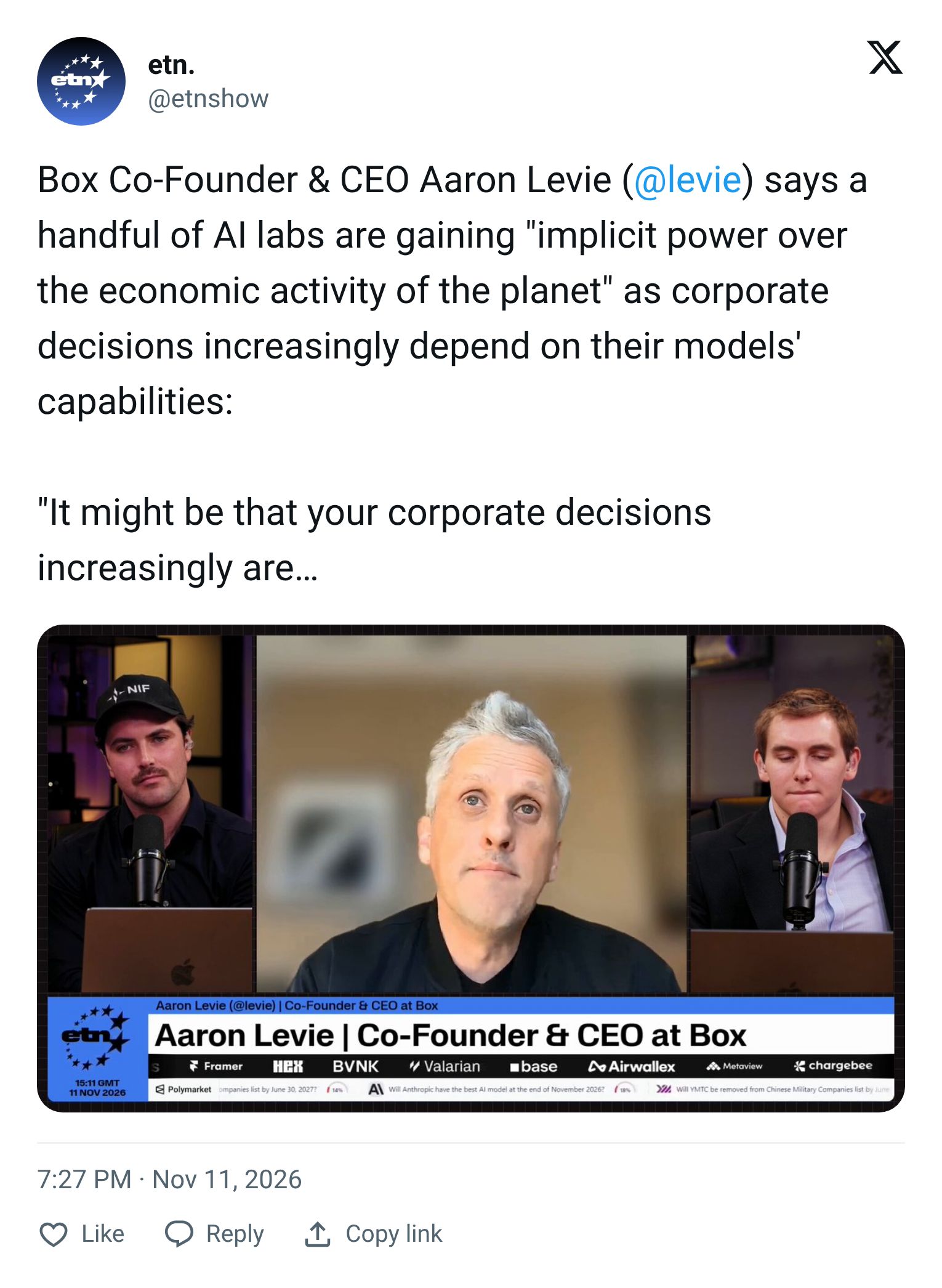
Box Co-Founder and CEO Aaron Levie came on the show and explained why a handful of AI labs could end up holding enormous power over the global economy.
He argues that corporate decisions could increasingly depend on “three or four companies and their underlying substrate of intelligence.” From financial markets to healthcare and manufacturing, entire industries could become “intertwined with the capabilities” these labs choose to train into their models.
Levie says you can already see this happening when models suddenly get better at things like 3D modelling and animation. As he puts it, “You're weirdly at the mercy of probably three researchers at one lab” deciding to spend “$10 million of RL data on one topic”.
Watch the full clip below.
Continental Breakfast
