
What a time to be live. The main thing happening today is Jensen Huang plotting his return to Nvidia. Live from 12 GMT. Here’s your Order of Play plus an Op-ed from Lucas on getting rid of titles.

12:00 PM - Mustafa Neemuchwala, Chief Business Officer at Valarian
12:30 PM - Christian Angermayer, Founder & CEO at Apeiron Investment Group
1:15 PM - Carina Namih, General Partner at Plural
1:30 PM - Tyler Denk, Co-Founder & CEO at Beehiiv
2:00 PM - Jonathan Hunt, VP of Media & Head of The Hustle at HubSpot
2:30 PM - Hanno Renner, Co-Founder & CEO at Personio
What’s Happening Today
Jensen Huang is already plotting his return to Nvidia.
Just days after resigning following reports of affairs with a subordinate and a suspected Chinese spy, Huang is discussing a comeback with his allies in Silicon Valley. One supporter is putting together a "war room" of tech executives to pressure Nvidia's board into bringing him back, and they're even hoping to get the White House involved.
Elon Musk and Epic Games CEO Tim Sweeney are among those backing a public letter calling for Huang's reinstatement. Two major Nvidia investors, Brad Gerstner and Gavin Baker, have also urged the board to keep the option open. One ally claimed that "everyone that matters in tech outside the frontier labs loves Jensen."
However, Huang's relationship with an executive at Singapore-based Megaspeed has raised concerns about Nvidia's chip sales to Asian customers with potential links to China. The board is investigating, and even one person campaigning for his return admitted that having an affair with a subordinate is a fireable offence.
CFO Colette Kress is currently running the $4 trillion company as interim CEO, and the board has reportedly approached Arm boss Rene Haas about replacing Huang. US Treasury secretary Scott Bessent has also called for a "dramatic shake-up" in leadership.
Huang built Nvidia into one of the world's most valuable companies, but unlike some other tech founders, he doesn't own enough shares to overrule his board.
We're getting into all of it on today's show at 12 GMT.
Daily Op-Ed — No Titles, No Managers?
Today we're joined in the studio by Tyler Denk. He's the co-founder and CEO of beehiiv, the newsletter platform that recently crossed $3m in monthly recurring revenue. Earlier this month he announced on X that beehiiv was getting rid of job titles altogether, his own included, so there are no more VPs, Directors or C-suite.
There's a growing trend among tech founders to do this. Fed up with big org charts and peacocking, plenty have started cutting titles and management layers so that hiring is easier and they're closer to the actual work again.
The idea comes up with a few of our guests. ElevenLabs got rid of titles a while ago, and Victoria Weller, who runs operations there, told us: "titles can get in the way of agility… we don't want strict lanes and strict ladders." Her verdict was that it was "absolutely worth it".
When Bercan Kilic of microagi came on the show in October, he told us his team had "abolished the co-founder title completely, because it doesn't matter who joined earlier. What matters is who is bringing what value."
I think a lot of it comes down to speed. If nobody's a "Head of" anything, you're not waiting on three people to sign something off or sitting in meetings about who owns what. Tyler said beehiiv had spent "hundreds of collective hours" in meetings about title changes alone, and none of it did anything for their customers.
Yet some very big companies have given it a go and then quietly put the structure back. Take Google in 2002. Page and Brin decided they didn't want engineering managers at all, and wanted it to feel more like a university lab than a company. A few months in, Page had people queuing up with expense reports and arguments with colleagues, so that was the end of that. Years later, Google's people team set out to prove that managers didn't matter, and as one of the leads, Neal Patel, put it: "Luckily, we failed."
GitHub is probably the best-known example. For its first six years it had no managers or titles, until in 2014 Chris Wanstrath took over as CEO and started bringing bosses back. As he put it, "I might be building something here, not even knowing that Paul is building something over here."
In both cases the problem wasn't really the titles. Once the company got big enough, nobody was quite sure who was in charge of what.
That said, there are plenty of success stories. Tyler mentioned he got the idea from Bending Spoons, which has managed to go a decade without job titles. He wrote in his newsletter that it really "crystallized" when he listened to David Senra's interview with co-founder Luca Ferrari, who said arguing over who should be a director or a senior engineer was "emotionally draining", and that "we have never reintroduced them again."
Tyler's honest about the fact that the new system isn't perfect, but said "when I'm stuck choosing between two imperfect systems, I'll choose the simpler one every time." It's hard to argue with that, and I'm excited to hear on the show how the change is going.
— Lucas
etn. Insight
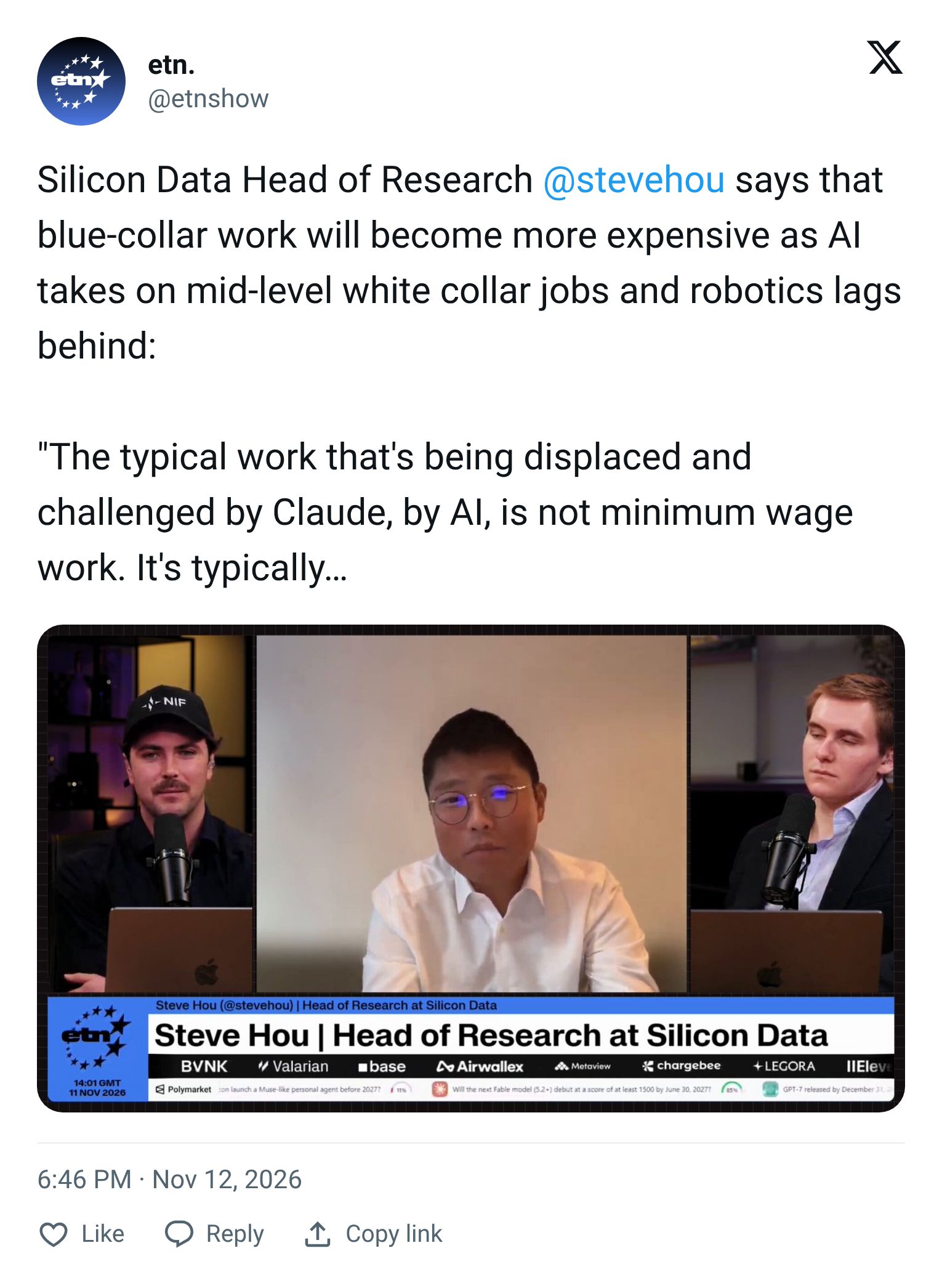
Silicon Data Head of Research Steve Hou came on the show and explained why he thinks blue-collar workers could become more expensive as AI takes on white-collar jobs.
The roles being challenged by AI aren't minimum wage jobs. Hou points to "the paralegal" and "a junior bank analyst" as examples. Meanwhile, minimum wage workers could become more expensive because "we don’t have humanoids running around."
He also points to a growing "populist backlash against immigration and cheap sources of labor" in developed economies, alongside ageing populations. With these pressures building, Hou thinks we could see people who previously worked in white-collar jobs "starting to pivot over to do stuff a bit different."
Watch the full clip below.
Continental Breakfast
